
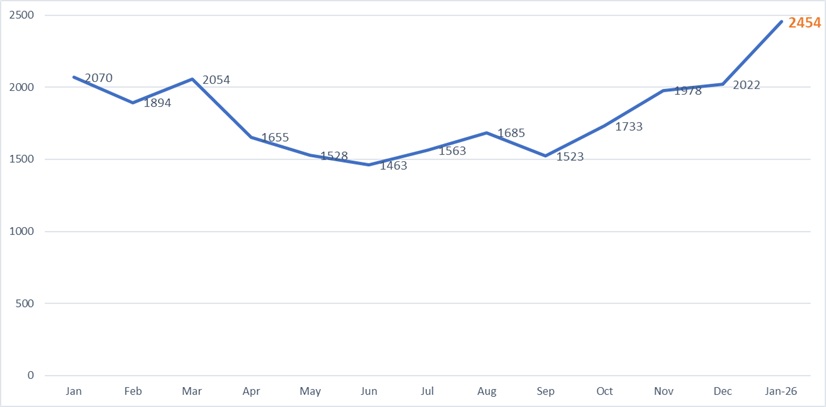
A historic milestone: Viet Nam welcomes nearly 2.5 million international visitors in one month
Figure 1. International visitors by month in 2025 and January 2026 (thousands of arrivals)
Source: Compiled from National Statistics Office’s data
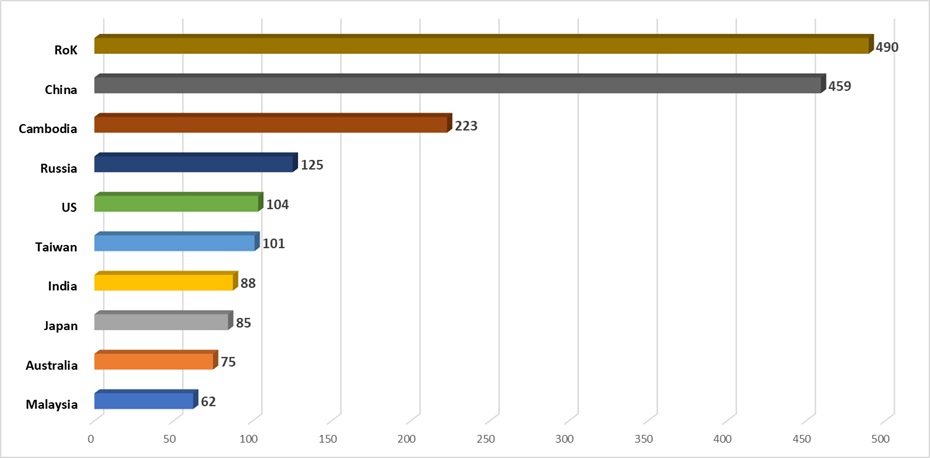
Asia remained the largest source region, contributing approximately 1.8 million arrivals and accounting for more than 73% of the total. South Korea retained its position as Viet Nam’s top inbound market with nearly 490,000 visitors. Growth from this market has been supported by extensive flight connectivity and strong demand for beach holidays, golf tourism, and family-friendly travel. Japan also recorded encouraging growth, particularly among higher-spending travelers, indicating a recovery in quality segments. Meanwhile, although arrivals from China dipped slightly year-on-year, the market maintained significant scale with nearly 460,000 visitors, reaffirming its role as Viet Nam’s second-largest source market.
Southeast Asia continued to demonstrate dynamic growth. Visitor numbers rose sharply from the Philippines, Singapore, and Indonesia, while Cambodia recorded the most notable surge, with arrivals more than doubling year-on-year. These gains underline the effectiveness of ASEAN tourism cooperation frameworks, as well as advantages in geographic proximity, affordable travel costs, and convenient regional transport links.
India emerged as one of the most promising growth markets, reaching nearly 88,000 visitors in January – an 80.5% year-on-year increase. The rapid rise highlights the success of Viet Nam’s efforts to diversify source markets and tap into India’s expanding outbound travel demand, supported by new air routes and targeted promotion.
Figure 2. Top 10 source markets in January 2026 (thousands of arrivals)
Source: Compiled from National Statistics Office’s data
Europe stood out as a major growth driver, welcoming around 424,000 visitors, up nearly 60% compared to the same period last year. Key markets including Russia, the United Kingdom, France, and Germany all recorded double-digit growth. Russia and Poland showed particularly strong rebounds. Favorable visa policies, expanded direct flight routes, and Viet Nam’s appeal as a warm, long-stay winter destination contributed to the surge. European travelers are also known for longer stays and higher spending, generating substantial value for the tourism economy.
Long-haul markets showed stable performance. The Americas delivered steady gains, led by the United States with over 103,000 arrivals, while Oceania recorded healthy growth driven largely by Australia. These markets are considered relatively stable and less sensitive to short-term seasonal fluctuations.

Overall, the broad-based expansion across both traditional and emerging markets points to increasing diversification and resilience in Viet Nam’s inbound tourism structure. The record-breaking performance in January not only reflects strong demand but also the impact of proactive visa facilitation, improved air connectivity, diversified tourism products, and sustained promotion efforts. If current momentum continues, 2026 could become a landmark year for Viet Nam’s tourism industry, strengthening its competitiveness and position on the global tourism map.
